
Nishee Malik joined Sparsh Global Business School in 2024 with clear vision. Not vague hopes about "getting a good job" or "maybe doing well." Specific targets. She wanted to grow. Become successful. Build a career that mattered.
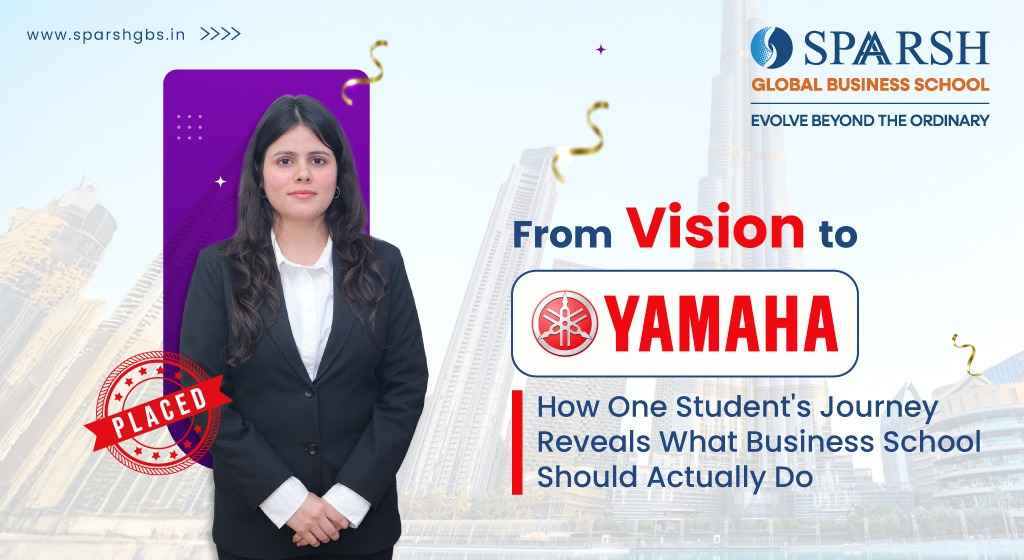
Two years later? Management Trainee at Yamaha Motor Solutions Limited.
Impressive outcome, sure. But here's what matters more—she doesn't view this as arrival at some destination. She sees it correctly as beginning of much larger professional journey. That mindset difference separates students who plateau after first placement from those who build exceptional careers over decades.
Her success story reveals something crucial about what business education should accomplish but often doesn't. Most business schools focus purely on academic knowledge—teach theories, test memorisation, celebrate high grades. Then students graduate, enter the corporate world and discover grades that predict almost nothing about who succeeds professionally.
At Sparsh Global Business School, we've rejected that model completely. Academic knowledge matters, obviously. But it's table stakes, not differentiators. What actually separates candidates who land roles at companies like Yamaha from those who struggle? Discipline. Analytical thinking. Confident communication. Professional mindset shaped through experiences beyond just classroom lectures.
Let me show you how this actually works by examining what made Nishee's journey successful—and what it reveals about business education done properly.
Vision Beats Vague Ambition Every Time
When Nishee started her PGDM in 2024, she arrived with something rare—clarity about what she wanted building. Not someday dreams. Immediate goals she could work toward systematically.
Most students don't have this. They join business school hoping things work out somehow. Maybe placements will be good. Maybe they'll discover passion. Maybe opportunities will appear. That passive approach produces mediocre outcomes consistently.
Vision changes everything about how you use two years. When you know where you're headed, every choice gets filtered through simple question—does this move me closer or not? Elective selection becomes strategic rather than random. Gemini said
Project choices align with career goals rather than just picking the easiest options available. Networking happens purposefully with people who can help your specific trajectory. At SGBS, we do not just accept students and hope they figure things out. From day one, our approach focuses on helping each student clarify their vision, but we also ensure they build a systematic path toward it.The i-EVOLVE metric we use tracks development across multiple dimensions specifically because successful careers require more than just grades.
Entrepreneurial mindset. Values alignment. Objectivity. Lateral thinking. Versatility. ESG orientation. These aren't abstract qualities—they're measurable capabilities that separate exceptional careers from ordinary ones. We help students develop deliberately in each area rather than hoping professional qualities somehow emerge accidentally.
Skills That Actually Matter Get Built Through Experience
Nishee credits three specific capabilities for her success. Discipline. Analytical thinking. Confident communication. Worth examining what this actually means and how SGBS develops these differently than traditional business schools.
Discipline is not about following a set of rules with blind obedience. It is about keeping your eyes on the long-term prize when short-term distractions start to look tempting. It means showing up and putting in the hours even when your initial motivation has begun to waver. True discipline is doing the difficult work that others might avoid, simply because you know it moves you a step closer to where you want to be.
Most traditional business schools try to force discipline through attendance registers and the pressure of looming deadlines. This often results in superficial compliance rather than any real sense of self-direction. At SGBS, we develop genuine discipline through our residential programme, where students must learn to manage their own lives and schedules independently. We see it in the 'Startup Garage', where entrepreneurial projects demand sustained effort without a professor constantly breathing down a student's neck. It is also built through our corporate mentorship programme, but here, the stakes are different; disappointing a mentor who is genuinely invested in your success carries much more weight than simply losing a few marks on a test.
Analytical thinking is not about memorising a list of frameworks from a textbook. It is the ability to break a complex problem into its smaller parts, evaluating every option systematically and reaching a sound conclusion even when you do not have all the information.
We develop this skill through a curriculum that is contextually tailored to solve actual business challenges. We do not use 'sanitised' case studies that come with neat, pre-packaged answers. Instead, our students face the messy, real-world problems that companies are dealing with right now, where multiple approaches might work and one must evaluate the trade-offs intelligently. Our 'Business Simulation Laboratory', which is powered by tools from Harvard, Bloomberg and Capstone, allows students to make these analytical decisions repeatedly. They get to watch the consequences unfold in real time, building a level of pattern recognition that no textbook could ever provide.
Finally, confident communication is about much more than just speaking clearly. It is the art of articulating an idea persuasively to an audience with different priorities. It involves handling pushback professionally and learning how to adapt a message based on exactly who is sitting across the table.
At SGBS, we develop this through constant interaction with our corporate mentors, who are senior business leaders rather than just academics. Our students are regularly required to present their solutions to actual company problems, where real stakeholders will challenge their recommendations and demand evidence for their ideas. Through global immersion programmes at NUS Singapore and partner institutions where you're communicating across cultural differences constantly.
By graduation, these capabilities aren't theoretical knowledge about discipline, analysis and communication. They're demonstrated repeatedly through two years of experiences specifically designed for developing them.
Holistic Development Isn't Marketing Language
The video mentions SGBS focuses on "holistic development" shaping student mindset through experiences inside and outside classroom. Most schools claim this whilst doing nothing substantive beyond academics. Worth examining what it actually means when done properly.
Inside the classroom, holistic development means our curriculum covers far more than just management fundamentals. Win @ Work modules focus specifically on workplace realities—navigating office politics, managing difficult stakeholders, building professional relationships. Most schools ignore these entirely despite them mattering enormously for career success.
Our 4E approach—Experiential learning, Experimental approach, Entrepreneurial spirit, Environmental consciousness—ensures students aren't just passive information recipients. Success in the modern business world is rarely about how much information a student can memorise. It is about how they investigate new ideas, test their theories and take calculated risks while considering the broader impact of their decisions. At Sparsh Global Business School, we believe that true professional growth happens when a student looks beyond just profitability.
Outside of the traditional classroom, holistic development is woven into the very fabric of our residential programme. This creates a unique community where students learn from each other constantly. Growth also happens through social immersion projects that address real-world community challenges, and through participation in high-level conferences and industry competitions that build vital networks.
Furthermore, our global immersion programmes at partner institutions are certainly not tourism disguised as education. These are genuine academic experiences designed to develop the cross-cultural competence and international perspective essential for ambitious careers in an interconnected world.
Learning Through Action and Experience
The 'Startup Garage' at SGBS is not an incubation centre that simply collects dust. It is an active, vibrant space where entrepreneurial students receive real funding to test their business ideas. It is a place for learning from failures and, occasionally, building ventures that continue long after graduation.
Corporate mentorship throughout the programme ensures that students are not restricted to textbooks and lectures. They receive direct guidance from senior leaders who are actively running businesses. These mentors share unfiltered insights about what actually works in the boardroom versus what only sounds good in theory. All these elements combine to develop students who are professionally ready, not just academically knowledgeable. That is what ‘holistic’ means in a practical sense—developing a complete professional capable of thriving in a corporate environment, not just passing an examination.
Why the Right Platform Matters
Nishee Malik specifically mentioned her gratitude for the guidance, exposure and support that SGBS provided. This was not a mere polite acknowledgement; it was a recognition that the right platform matters enormously for career outcomes. Being sponsored by the Sparsh Group of Industries—a conglomerate with five decades of excellence across chemicals, hospitality, renewable energy and real estate—provides advantages that typical business schools simply cannot match.
This ‘Corporate DNA’ is not an abstract concept. It means a curriculum designed by industry practitioners alongside academics. It means corporate mentors who are current senior leaders, not retired executives. It also means access to real business challenges for projects and a 'Startup Garage' with actual funding, because a business house understands that entrepreneurship requires capital.
The guidance Nishee referred to is not found in occasional counselling sessions. It is continuous mentorship from people who have built successful careers themselves. They share the unvarnished truths about different paths, help students navigate choices strategically and often facilitate the introductions that open doors which might otherwise stay closed.
Exposure and Genuine Support
Exposure means having the opportunity to experience business far beyond the campus boundaries. Company visits are not superficial tours; they are deep dives into operations with access to senior management. Similarly, industry projects solve actual challenges rather than serving as theoretical exercises.
Support means that the institution is genuinely invested in a student's success. Our scholarship fund, a multi-crore initiative, is designed to prevent financial barriers from shutting out promising students. We start career development in the very first trimester, not waiting until the last semester. Faculty and mentors are readily available all along the way. The quality of the platform often determines whether students succeed in their careers or, despite their abilities, face setbacks due to a lack of important opportunities at crucial times.
The Beginning of a Global Journey
When Nishee secured her role as a Management Trainee at Yamaha Motor Solutions, outsiders saw a successful placement. However, she understood correctly that it is merely the starting point for a much larger professional journey.
That viewpoint is key. Students who see their initial job as the pinnacle of success frequently hit a wall. If they don't have a subsequent goal in mind, their career can stagnate. Nishee's future-focused mindset means her position at Yamaha is a deliberate step in a larger plan she's already charted. She's already thinking about the skills she'll acquire, the connections she'll make, and the opportunities this role will open up for her later. At Sparsh Global Business School, we're pleased to help cultivate such ambitious, forward-thinking careers.
Frequently Asked Questions
Que.1) How does SGBS develop the core skills that Nishee credits for her success?
Ans) We build these capabilities through structured, real-world experiences. Discipline is forged in our residential programme and 'Startup Garage' where students manage projects independently. Analytical thinking is sharpened in our 'Business Simulation Laboratory' by solving messy business problems. Confident communication grows through regular interaction with senior corporate mentors and global immersion programmes.
Que.2) What makes the SGBS approach to placements different from other business schools?
Ans) Our placements carry the credibility of the Sparsh Group of Industries and five decades of corporate relationships. Career development starts in the first trimester with personality building and mock interviews. We use the 'i-EVOLVE' metric to show recruiters documented evidence of professional growth beyond grades. This ensures students arrive at interviews with the exact blend of discipline and readiness that global companies demand.
Que.3) What is the advantage of learning through business simulations?
Ans) Business simulations allow students to make strategic decisions in realistic business scenarios. This hands-on approach strengthens analytical thinking, improves decision-making abilities, and prepares students for real-world corporate challenges.
