


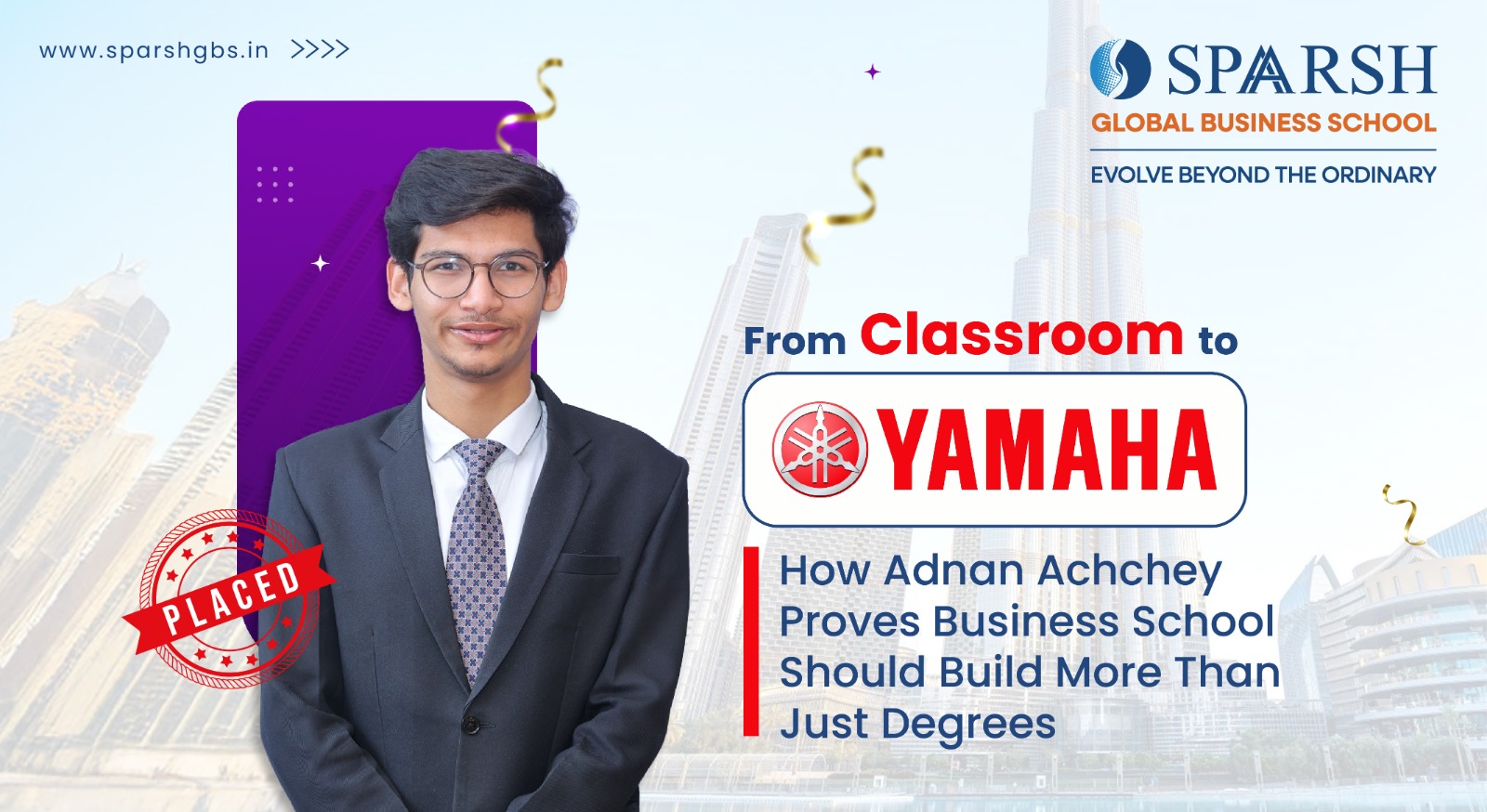
Adnan Achchey walked into Sparsh Global Business School in 2024 with specific intentions. Not vague hopes about "getting placed somewhere decent." Clear focus. Learn systematically. Grow deliberately. Prepare himself properly for professional world's actual demands.
Two years later? Management Trainee at Yamaha Motor Solutions Limited.
Impressive outcome on its surface. But here's what matters more—he didn't choose Yamaha randomly or settle for whatever appeared. He targeted organisations with global standards and strong financial discipline specifically. That precision in career choices reveals something crucial about what his business school experience actually delivered.
Most students graduate clutching degrees and hoping opportunities work out somehow. Adnan graduated with clarity about what he wanted, discipline to pursue it systematically and confidence he could deliver once given the chance. That's a fundamentally different preparation—and it's exactly why he's starting his professional journey at Yamaha whilst many equally intelligent peers are struggle finding roles that genuinely excite them.
His success exposes uncomfortable truths that most business schools avoid acknowledging. Degrees alone don't build careers that matter. What really builds an exceptional career is having total clarity about your direction, understanding the actual skills companies are looking for and having the confidence to perform when the pressure is on. At Sparsh Global Business School, we have structured every single thing around developing those exact qualities—we aren't just here to hand out certificates after two years and send you on your way.
Let me show you how this works by examining what made Adnan's journey successful and what it reveals about business education done properly.
Purpose Beats Passive Participation Consistently
When Adnan joined SGBS in 2024, he arrived with the purposeful approach most students lack. He knew precisely why he was there. Learning. Growth. Professional preparation. Not collecting degrees and hoping things work out afterward.
That intention changed everything about how he used these two years. Where classmates drifted through required coursework, he extracted every lesson applicable to career goals he'd identified. Where others participated because attendance mattered, he engaged because capabilities being developed would matter professionally. Where people viewed activities as boxes to tick, he saw them as opportunities building specific skills he'd need.
At SGBS, we don't just accept students and let them wander hoping they accidentally discover purpose. Our approach from day one focuses on helping each student clarify their vision and build systematic path toward it.
The i-EVOLVE metric we use tracks development across multiple dimensions because successful careers require far more than grades. Entrepreneurial mindset. Values alignment. Objectivity. Lateral thinking. Versatility. ESG orientation. These aren't abstract qualities—they're measurable capabilities separating exceptional careers from mediocre ones.
Adnan understood this instinctively. He didn't obsess purely over exam scores whilst ignoring everything else. He recognised that companies like Yamaha evaluate candidates holistically—academic knowledge matters, but so does professional thinking, disciplined execution and confident communication under pressure.
Being a corporate-sponsored business school means we understand this viscerally. Sparsh Group of Industries didn't build multi-industry conglomerate through academic excellence alone. They combined knowledge with execution discipline, strategic thinking and sustained effort over decades. That DNA permeates everything at SGBS.
Clarity, Discipline and Confidence Don't Come From Textbooks Alone
Adnan specifically credits SGBS for providing more than just a degree. He gained real clarity about his career path, a genuine discipline in his approach and a level of confidence in his own capabilities. It is worth examining how a business school actually delivers on these fronts, especially when so many institutions claim to do the same but ultimately fall short when it comes to the real solution.
Clarity emerges through our contextually tailored curriculum solving real business challenges. Not sanitised case studies with neat predetermined answers—messy actual problems companies face where multiple approaches might work and you need evaluating trade-offs intelligently. Working through dozens of these throughout the programme helps students understand what they're genuinely good at, what energises them and where they have gaps in building careers.
Our corporate mentors—senior leaders who are actually out there running businesses—provide the kind of unfiltered guidance you just won't find in a textbook. They share the blunt truths about what various roles actually involve, looking well beyond what the recruitment brochures tell you. They help students evaluate their options strategically, focusing on where they will genuinely fit in rather than just chasing a prestigious title or a flashy compensation package.
Global immersion programmes at NUS Singapore and our other partner institutions expose students to international business practices first-hand, helping them grasp opportunities that exist well beyond the domestic market. Many students actually discover career interests they never even knew existed through these experiences.
Discipline is built through our residential programme, where students have to manage themselves without parents constantly supervising every move. This independence is often where the real growth happens. Through startup garage where entrepreneurial projects require sustained effort over months without professor pushing you daily. Through our Win @ Work modules, we focus on the stark realities of the workplace—where simply showing up and being present matters enormously for the final outcome.
Most traditional business schools try to teach discipline through basic attendance requirements and the constant pressure of looming deadlines. However, that usually just results in a bit of superficial compliance rather than any genuine self-direction. At SGBS, we prefer to develop real discipline through experiences where students see first-hand how their consistency actually determines their results. It isn't just about the grades on a page; it’s about actual project success, building lasting professional relationships and the genuine development of their own capabilities.
Confidence isn't something you can teach in a lecture; it emerges naturally from repeatedly succeeding at challenging experiences throughout the programme. It is about proving to yourself that you can handle whatever is thrown at you. Our Business Simulation Laboratory powered by Harvard, Bloomberg and Capstone tools lets students make hundreds of business decisions and watch consequences unfold. By graduation, they've navigated complex scenarios successfully enough times that facing new challenges doesn't paralyse them with uncertainty.
When Adnan interviewed at Yamaha, he wasn't faking confidence or hoping they wouldn't expose his lack of preparation. He had genuine confidence because he'd demonstrated capabilities repeatedly throughout two years. He knew he could think professionally and perform with excellence because he'd done it dozens of times already in different contexts.
Professional Thinking Separates Good Students From Good Employees
Adnan emphasises that SGBS equipped him to "think professionally and perform with excellence." Most people tend to gloss over this without really understanding what it means or why it matters so much in the long run.
Professional thinking is about far more than just memorising business frameworks from a textbook. It is about approaching problems the same way an experienced leader would—considering the perspectives of different stakeholders, evaluating options systematically even when information is missing and balancing immediate pressures against long-term consequences. It also means learning how to communicate those recommendations persuasively to people who may have very different priorities.
We develop this through constant interaction with corporate mentors throughout the entire programme. Students present solutions to actual company problems, where senior leaders then challenge their ideas. They learn very quickly that the "academic" answers which might satisfy a professor are a world away from the practical solutions that actually convince experienced business people.
Our 4E approach—Experiential learning, Experimental mindset, Entrepreneurial spirit and Environmental consciousness—ensures that our students are never just passive recipients of information. They are out there investigating, testing ideas, taking calculated risks and considering the broader impact of business decisions beyond just the bottom line.
Excellence in performance comes from our heavy emphasis on delivering results, rather than just ticking off assignments. In our Startup Garage, your business idea either gains traction or it doesn't—effort alone simply won't guarantee success. In the simulation lab, your company either thrives or struggles based on the choices you make. In industry projects, clients either find your work valuable or they don't. It is as straightforward as that.
This focus on results prepares students for a professional environment where, quite frankly, intentions often matter far less than outcomes. Yamaha did not hire Adnan simply because he "tried his best" or had good intentions; they hired him because they were entirely confident he could deliver the specific results they needed.
The Quality of the Platform
Adnan mentions that guidance from experienced faculty and corporate mentors was crucial for his development. This isn't just a polite nod to his teachers—it is a recognition that the quality of the platform you are on matters enormously for your career outcomes.
Being sponsored by the Sparsh Group of Industries provides advantages that typical business schools simply cannot match. That "corporate DNA" means the curriculum is designed by industry practitioners alongside academics. Our corporate mentors are current senior leaders actively running businesses, not retired executives. This gives students access to real business challenges across multiple Sparsh Group industries for their projects. Even our Startup Garage comes with actual funding, because a proper business house understands that entrepreneurship requires capital, not just a good idea.
Furthermore, our global partnerships with NUS Singapore, the Frankfurt School of Finance & Management and Northern Kentucky University are not just "paper agreements" that nobody actually uses. They are active collaborations providing genuine international exposure at a fraction of what a standalone international MBA would cost.
There is also a level of placement credibility that comes when companies know graduates are coming from an institution backed by a respected corporate house with five decades of excellence. When the SGBS placement team contacts Yamaha or similar organisations, they aren't some unknown business school making cold calls; they are representing an institution with a genuine corporate pedigree.
The guidance Adnan received wasn't just the occasional career counselling session. It was continuous mentorship from people who have built successful careers themselves. They shared the unvarnished truths about different paths, helped him navigate his choices strategically and likely facilitated the kind of introductions that open doors which might otherwise stay firmly closed.
The Beginning, Not the Destination
When Adnan secured his Management Trainee role at Yamaha Motor Solutions, he viewed it exactly the right way—as the beginning of a larger professional journey, rather than a final destination.
That perspective is really what separates people who build exceptional careers from those who plateau quickly. Students who view their first placement as the ultimate achievement often tend to stagnate within months. By staying hungry and recognising that the learning never truly stops, you ensure that your career continues to move upward.They landed the job, accomplished the goal, checked the box. Now what?
Adnan understands this role serves a specific purpose in a longer trajectory. Yamaha provides platform building capabilities in organisation with global standards and financial discipline he values. What will he learn there? What networks will he develop? What options will this position create for moves afterward?
At SGBS, we deliberately structure programmes developing this longer-term thinking. Our i-EVOLVE metric tracks growth across dimensions mattering throughout entire careers, not just first placement. Career workshops focus on trajectory spanning decades, not just surviving recruitment season. Alumni panels showcase diverse paths including unconventional choices working brilliantly long-term.
Students graduating from top business school in Delhi NCR, Sparsh Global Business School carry more than their PGDM degree and first job offer. They have clarity about where they're headed, demonstrated capabilities beyond academics, professional networks spanning industries, entrepreneurial mindset enabling them creating opportunities rather than just seeking them and confidence from repeatedly succeeding at challenging experiences.
That's fundamentally different preparation than conventional business schools provide. And it's precisely why students like Adnan land roles at organisations they genuinely wanted joining whilst viewing those placements correctly—not as destinations, but as strategic steps in much larger journeys they're building deliberately.
Frequently Asked Questions
Q1. How does SGBS develop clarity, discipline and confidence that Adnan credits for his success?
SGBS develops clarity through contextually tailored curriculum solving real business problems helping students understand their genuine strengths, corporate mentors providing unfiltered career guidance and global immersions exposing international opportunities. Discipline emerges from residential programme requiring self-management, startup garage demanding sustained entrepreneurial effort and Win @ Work modules where consistency determines outcomes—not superficial compliance but genuine self-direction. Confidence builds through repeatedly succeeding at challenges in our Business Simulation Laboratory, presenting solutions to senior business leaders and completing difficult projects demonstrating capabilities. By graduation, students have proven to themselves they can perform professionally.
Q2. What makes SGBS different from other business schools in preparing students for companies like Yamaha?
SGBS is corporate-sponsored by Sparsh Group with five decades of business excellence, providing genuine corporate DNA throughout education. Curriculum gets designed by industry practitioners, not just academics. Corporate mentors are current senior leaders actively running businesses. Students solve real challenges across Sparsh Group industries, not sanitised textbook cases. Our Business Simulation Laboratory powered by Harvard, Bloomberg and Capstone develops professional decision-making through hundreds of practice scenarios. Global partnerships provide international exposure at accessible cost. Most importantly, our holistic approach develops professional thinking and execution excellence companies like Yamaha actually need—not just academic knowledge.
