

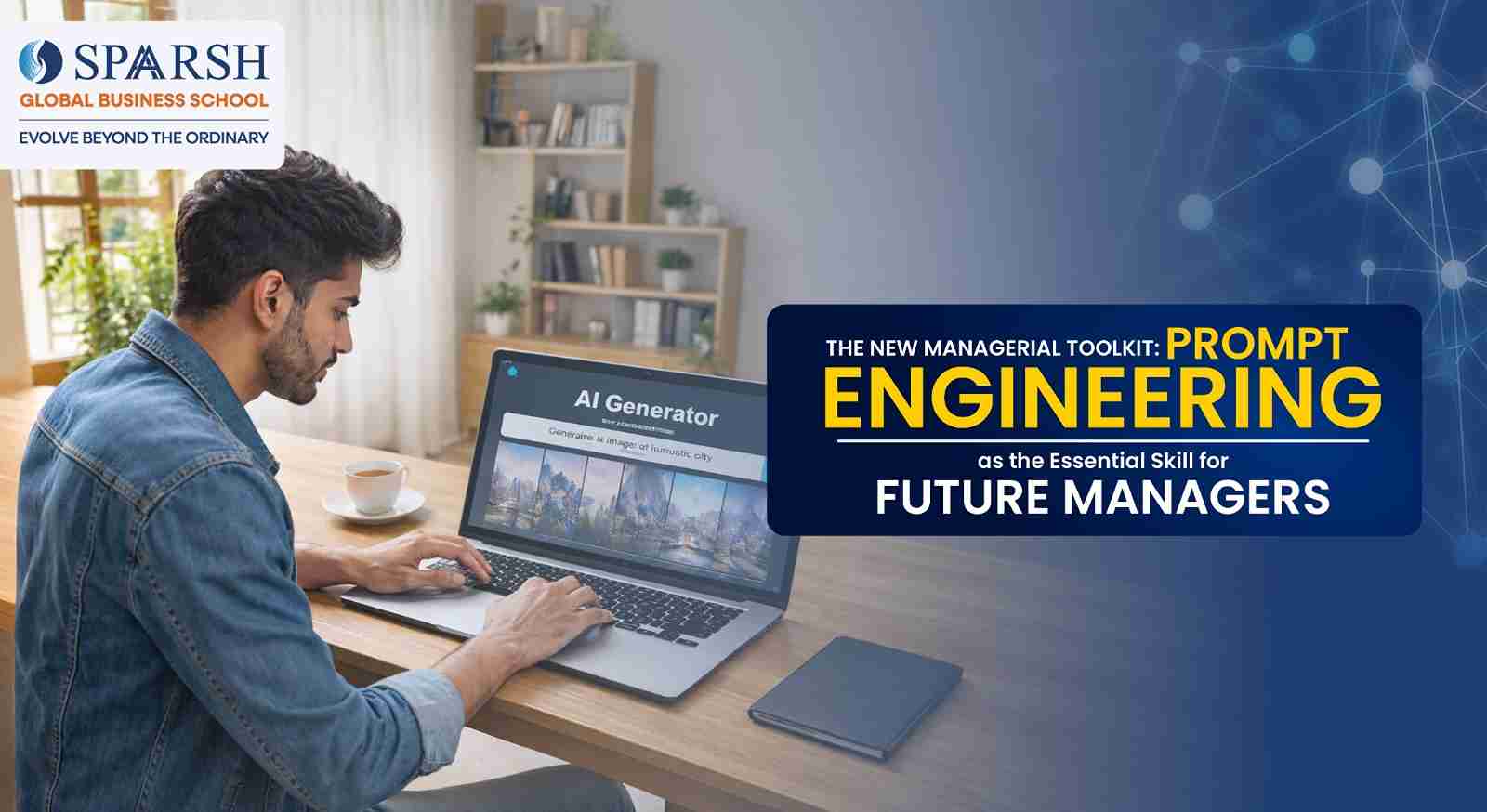
Management education has always adapted to technological shifts. We've seen this happen with computers, the internet and mobile technology. Now artificial intelligence is rewriting the rules again. But this time, something's different. Managers don't just need to understand AI—they need to communicate with it effectively. That's where prompt engineering comes in. It sounds technical. It isn't really. Think of it as learning how to ask the right questions and give clear instructions to AI systems. Your children are entering business schools at precisely the right moment. The managers who master prompt engineering now will lead their industries tomorrow. Those who ignore it risk becoming irrelevant faster than they'd imagine.
Business schools have recognised this shift. They're rebuilding curricula around skills that actually matter in AI-powered workplaces. Prompt engineering sits at the centre of this transformation because it determines how effectively managers can leverage artificial intelligence tools.
What Prompt Engineering Actually Means
Strip away the jargon and prompt engineering is quite simple. It's the skill of instructing AI systems to produce useful outputs. A manager might need market analysis, customer segmentation or financial forecasting. The AI can do all of this, but only if asked properly.
Poor prompts get poor results. Vague instructions produce vague outputs. Specific, well-structured prompts deliver actionable insights. The difference between a mediocre manager and an exceptional one might simply be how well they communicate with AI tools.
Sparsh Global Business School has integrated prompt engineering across multiple subjects because it's not a standalone skill. It touches Marketing, Finance, Operations and Human Resources equally.
Why Traditional Management Skills Aren't Enough
Your generation managed teams through direct supervision. Tomorrow's managers will supervise both humans and AI systems. That requires a different skill set entirely.
Consider a typical management scenario. Market research used to take weeks. Teams collected data, analysts crunched numbers and reports appeared eventually. Now an AI can analyse thousands of customer reviews in minutes, but only if someone asks the right questions. That someone needs prompt engineering skills.
SGBS students learn to frame business problems as effective prompts. They discover which details matter and which ones confuse the system. This practical knowledge separates graduates who thrive from those who struggle.
The Competitive Advantage Nobody's Talking About
Most business schools still teach management as if AI doesn't exist. They focus on traditional frameworks and case studies from pre-AI eras. That's a problem.
Companies are already hiring based on AI proficiency. Job descriptions increasingly mention prompt engineering alongside Excel and PowerPoint. The managers who understand this have a significant head start.
Here's what prompt engineering enables:
?Rapid data analysis that once required entire departments
?Personalised customer communication at scale
?Strategic scenario planning with multiple variables
?Automated report generation that frees time for decision-making
Students who graduate without these capabilities will compete against peers who have them. The gap will show immediately.
Learning to Think Like an AI Communicator
Prompt engineering changes how you approach problems. Traditional management education taught frameworks and theories. Prompt engineering teaches precision in communication. An effective prompt requires clarity about desired outcomesEnsuring Robust AI Engagement in Practical Application
It is vital, as we look to the future, that we provide the necessary context for your children—our students—to truly grasp the present business reality. The core issue facing all firms today isn't merely using AI; it's understanding how to ask the right questions of it.This principle underpins our approach at SGBS.At this institution, we don't merely lecture on 'prompt engineering.' Instead, we've carefully woven it into the fabric of our actual, live project assignments. Our students are presently working with bona fide artificial intelligence tools—the same ones they'll encounter post-graduation—tasked with resolving tangible commercial dilemmas.The learning methodology is deliberately hands-on: they discover what genuinely yields results through a process of trial, adjustment, and continuous iteration, rather than simply committing abstract conceptual frameworks to memory. The goal is a deep, practical competency.For example, when a student is required to draft an executive summary using a generative AI, they must first clearly define the format (e.g., a two-page internal memo), specify the necessary tone (perhaps rigorously impartial but subtly encouraging), and precisely outline the necessary depth of analysis (e.g., must feature cost-benefit figures alongside a risk matrix). These aren't just technical demands; they are the bedrock of effective managerial communication when interacting with powerful automated systems.
The Crucial, Unavoidable Ethics Component
Let's turn to a matter of profound importance: ethics. The output, or the quality of the information generated by any AI system, is entirely and non-negotiably dependent upon the initial input—the prompt itself. Where the prompt carries an inherent bias, the subsequent findings will, regrettably, be similarly skewed. Our future leaders must grasp this fundamental truth at a level deeper than theory.Therefore, our serious curriculum in prompt engineering necessarily incorporates rigorous ethics training. Students are taught the difficult but essential skill of discerning and identifying existing bias within their own formulated prompts. They come to understand, in stark terms, how automated intelligence has the potential to magnify established prejudices if it is not overseen with meticulous care. This specific sensitivity is absolutely indispensable when it comes to making decisions that ultimately impact staff, clients, and the wider community.
Navigating the Legal and Ethical Thicket
Furthermore, the legal landscape surrounding this emerging technology cannot, for a moment, be overlooked. Material generated by Artificial Intelligence naturally gives rise to complex and frequently unsettled points concerning copyright ownership—specifically, who retains the rights to the created text or image?the secure and lawful handling of personal data privacy, and, critically, the question of ultimate accountability should a systemic error or poor decision occur. It is therefore absolutely essential that the business managers we are diligently preparing for the coming decades are thoroughly equipped to navigate these nuanced, critical, and sometimes precarious issues with absolute assurance.It is therefore absolutely essential that the business managers we are preparing for the coming decades are thoroughly equipped to navigate these nuanced, critical, and sometimes precarious issues with absolute assurance.???? Practical Applications Across Business Functions
Moving on to immediate, practical uses, consider how Marketing managers now routinely employ prompt engineering. They are using it not only to rapidly generate fresh, creative campaign concepts but also to undertake sophisticated, large-scale analysis of current consumer sentiment. This speed and depth of insight are changing the nature of commercial strategy.Financial analysts employ it for risk assessment and forecasting models.
AI Integration in the Commercial Sphere
Across the board, the applications are proliferating daily. Consider, for example, how Human Resources specialists are now deploying AI to conduct the most rigorous screening of applicants or to carry out nuanced examinations of internal staff engagement. Practically every single commercial department is presently uncovering innovative means of integrating intelligent assistance into its day-to-day operations.
The managers who genuinely comprehend prompt engineering—that is, the critical art of soliciting the most accurate, useful information—are therefore strategically positioned to identify commercial opportunities that their less informed colleagues will inevitably overlook.
The SGBS Advantage
Our graduates from Sparsh Global Business School are entering the professional world already comfortable and proficient with these sophisticated instruments. Crucially, they haven't merely completed a single module; they've devoted two complete years to diligently honing their practical capacity to extract measurable, strategic value from powerful AI systems. That hands-on experience translates directly into immediate and meaningful workplace productivity.
The Necessary Shift in Managerial Education
The historical bedrock of management teaching—which focused heavily on making sound decisions despite incomplete or fragmented information—is now undergoing a profound reversal. Prompt engineering quite literally turns this model on its head. Today's managers can access comprehensive, detailed data analysis almost instantaneously. The critical challenge has therefore pivoted entirely from the scarcity of information to an absolute overload of it. The indispensable, preeminent skill now is becoming the facility to effectively sort the meaningful signal from the surrounding noise. Knowing which questions to ask matters more than knowing all the answers. Business schools that adapt their teaching to this reality produce graduates who actually succeed.
The transition requires more than adding an AI course. It means rethinking how every subject gets taught. Finance professors must teach prompt-based financial modelling. Marketing lecturers need to cover AI-assisted campaign development. This integration happens at forward-thinking institutions already.
Preparing for What Comes Next
AI technology evolves rapidly. Today's tools will seem primitive in five years. But prompt engineering principles remain constant. The ability to communicate clearly with intelligent systems will stay relevant regardless of technological changes.
Students learning prompt engineering now develop adaptability. They become comfortable with emerging tools because they understand the underlying logic. This flexibility proves more valuable than mastery of any specific platform.
The Bottom Line for ParentsYour children are investing significant time and money in management education. That investment should prepare them for actual workplace demands, not outdated business practices. Prompt engineering has moved from optional to essential remarkably quickly, especially within a future-focused PGDM Program. Business schools that ignore this do their students a disservice. Sparsh Global Business School has recognised where management education must go. By embedding prompt engineering throughout its PGDM Program curriculum, the school is ensuring that graduates possess the skills employers actually need. The managerial toolkit has changed fundamentally, and institutions that adapt fastest will produce leaders who succeed.
Frequently Asked Questions
Q1. Won't AI eventually replace managers if it can do so much analysis and decision-making?
AI handles data processing and pattern recognition brilliantly, but it can't replicate human judgement in complex situations. Managers provide context that AI lacks. They understand organisational culture, navigate office politics and make decisions involving ethical considerations. Prompt engineering makes managers more effective by giving them powerful tools, but the human element remains irreplaceable. Think of AI as an incredibly capable assistant rather than a replacement. Managers who learn to work alongside AI will outperform those who resist it.
Q2. Is prompt engineering just a temporary trend that will fade as AI becomes more user-friendly?
AI will certainly become easier to use, but that doesn't eliminate the need for prompt engineering. Consider how spreadsheets became more intuitive over decades, yet financial modelling skills remain valuable. As AI grows more sophisticated, the ability to extract maximum value through well-crafted prompts becomes more important, not less. Simple queries might get easier, but complex business applications will always require expertise in formulating effective prompts. The skill would evolve, rather than disappear.
