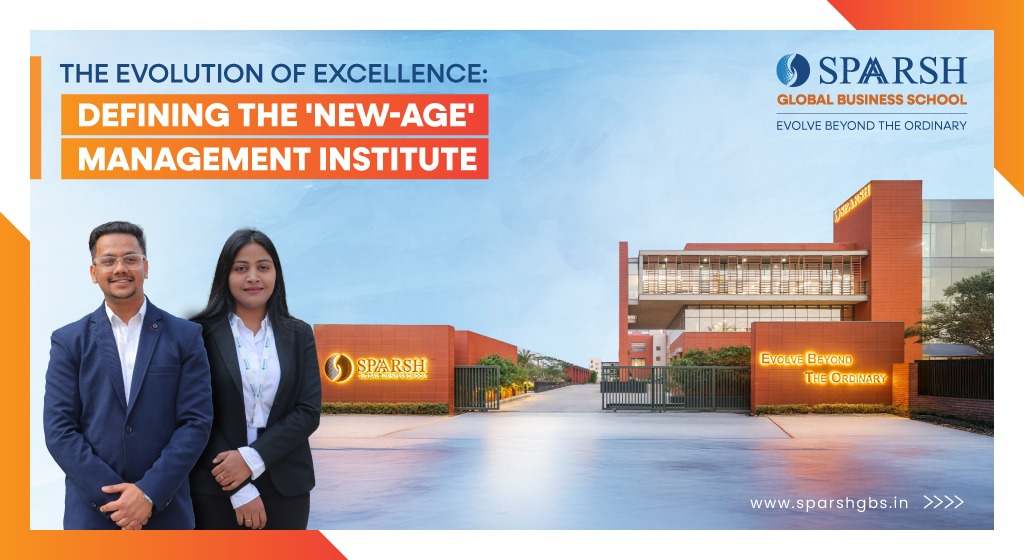
It is a genuine pleasure to see so many of you looking towards the future with such clear-eyed ambition. As you move from your undergraduate years into the professional world, you’ll likely hear the term ‘New-Age Institute’ quite a lot. It’s a phrase that marketing departments love to toss about, but we want to take a moment to explain what this actually means from our perspective at Sparsh Global Business School.
Beyond Bricks and Mortar
A common mistake is thinking a new-age institute is just about glass-fronted buildings or high-speed Wi-Fi. While grand infrastructure and top-tier facilities are certainly part of the package, they are merely the hardware. The true character of a modern institution is found in its “software” — how it thinks, how quickly it responds and how well it equips you for a future that is anything but predictable.
What we believe truly sets a modern PGDM Program apart is a concept we often describe as curriculum fluidity. Conventional MBA programmes often get bogged down by endless administrative layers and rather fixed academic systems; however, forward-thinking institutes like SGBS are built to stay adaptable. We don't find ourselves waiting through long approval cycles just to revise a syllabus or tweak a specific course module to keep it current.
Our programmes are developed in very close partnership with actual business leaders and active industry professionals, which ensures that the learning stays rooted in real-world practice rather than just dusty theory. This ensures that what you study on a Monday can be applied in an office by Friday. Consequently, when global events shift market dynamics or a new financial tool comes into play, it is brought into the classroom almost immediately. This means you aren't just studying what has already happened—you are being prepared for exactly what lies ahead.
Pedagogy: Looking Past Rote Learning
How something is taught is just as important as what is taught. For decades, education has leaned heavily on rote methods — memorising concepts simply to clear an exam. A new-age pedagogy prioritises project-based work instead.
This is a practitioner-led approach where the focus is on ‘Experiential Learning.’ We believe in Active Learning, where students might run a virtual company backed by an actual seed fund. It is one thing to read about venture capital; it is quite another to manage a real budget and make decisions that actually have consequences. At SGBS, we believe that making mistakes in a safe, simulated environment is the best way to ensure you don’t make them in the boardroom later.
Human-Tech Integration
In today’s climate, every school claims to be ‘tech-enabled.’ However, being a new-age student goes much further than just being handed an iPad. We focus on Human-Tech Integration. This is where we use technology not just to automate a task, but to teach empathy, connection and leadership. We use data tools to understand human behaviour, ensuring that the tech serves the person, rather than replacing that essential human touch.
A Positive and Productive Ecosystem
Finally, a true new-age institute offers a robust ecosystem that goes well beyond the four walls of a classroom. This includes a formal Startup Incubator for those of you with an entrepreneurial spark and a mentor network made up of seasoned global professionals. Our partnerships with international universities allow for smooth credit transfers, ensuring your education has a proper global footprint. By choosing SGBS, you aren't just earning a diploma; you are plugging into a network that will support you for the next many years of your career.
Frequently Asked Questions
Does a PGDM allow me to pursue a PhD later on?
Yes, provided the programme is recognised by the AICTE and holds AIU equivalency. This ensures your diploma is legally equivalent to a university degree for research or government roles in India and abroad.
Is a 'New-Age' curriculum more difficult than a traditional MBA?
It is more demanding in a practical sense. Instead of memorising notes, you solve real-world problems and manage projects. This active participation requires more critical thinking but makes you significantly more employable.
