When you're evaluating business schools, placements probably top your list. Faculty qualifications come next, maybe infrastructure after that. Makes sense—you're investing two crucial years and substantial money. But there's another question that matters just as much: will you know how to lead people fundamentally different from you? What happens when the frameworks you've learnt don't quite fit the problem you're facing?
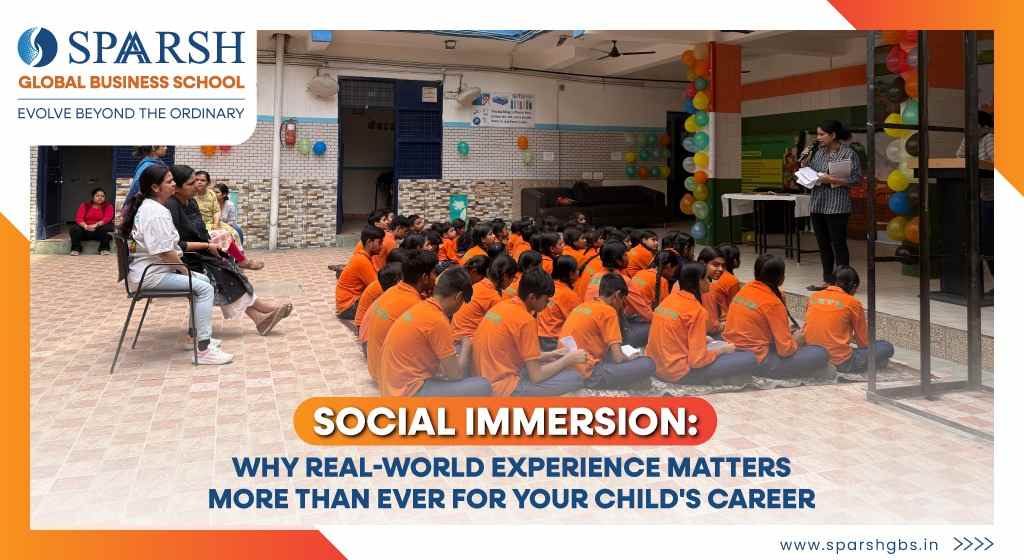
Something specific happens at Sparsh Global Business School during field projects. You arrive at a village in Odisha or an urban settlement project in Hyderabad. Strong academics behind you, clear career goals ahead. Two weeks pass. You return different, though not in some clichéd transformative way. Different because you've had to convince wary dairy farmers that your distribution model makes sense for them. Or persuade street vendors that your savings programme won't disappear with their money. These communities don't care about your entrance exam score or undergraduate institution. They care whether what you're proposing actually works for their lives.
That's what we mean by 'Human Premium'. Sounds like institutional language, perhaps. Except recruiters say exactly this during pre-placement discussions. Academically strong candidates? Available everywhere. Candidates who understand how markets genuinely function beyond theory? Remarkably rare. Social immersion develops this specific understanding. And frankly, it separates you in the final rounds when several candidates hold similar qualifications.
Frameworks Meet Actual Conditions
Your courses will teach strong analytical frameworks. Porter's competitive forces, market segmentation approaches, supply chain optimisation. Essential knowledge you'll definitely use.
Markets, however, don't follow textbooks very closely.
Take the handloom project from last year. Seemed manageable initially—weavers needed urban buyers, urban buyers wanted authentic handicrafts. Design better packaging, create a website, fix logistics. First-year Marketing material.
Failed badly at first. Weavers refused bank transfers completely. Production followed monsoon patterns, not customer demand. Village councils had to approve any outside collaboration. Traditional patterns carried religious meaning that couldn't just change because Pune buyers preferred pastels.
Complete reset required. Students learnt that listening worked better than any polished pitch they'd prepared. Trust took genuine weeks to build, not one good meeting. Solutions appeared only after understanding how these families actually lived, not what census data suggested about them.
Cannot learn this from cases, even excellent ones. Comes from failing, adjusting and eventually getting it right.
What Matters During Campus Recruitment
We've tracked this carefully for three placement cycles. Students with serious field experience get forty percent more interview opportunities than those without. Substantial difference.
Why does this happen? Field projects prove things that transcripts simply cannot:
- Communicating effectively across major cultural divides
- Building solutions with whatever resources actually exist
- Understanding why communities make particular choices
- Earning trust when you're the complete outsider
- Changing approach rapidly when obvious plans don't work
Something shifts during recruitment interviews when you discuss this work. Mention farmer cooperatives or waste management groups, and recruiters' attention sharpens noticeably. Questions move from testing memorised knowledge to exploring how you handled genuine complexity. Changes from 'explain this theory' to 'walk me through how you managed that situation'.
Recent graduate mentioned that his entire consulting final round discussed a water conservation project. The consultancy doesn't work in development at all. They wanted proof that you can handle messy situations and deliver without perfect conditions. He got the offer.
Discomfort Accelerates Growth
Real discomfort—not danger, we're rigorous about safety—changes you faster than comfortable learning ever will.
Social immersion at SGBS removes every familiar advantage. Good English? Helps minimally. City upbringing? Largely irrelevant. College reputation? Tribal cooperatives haven't heard of it and wouldn't care.
What's left? Whether you can observe properly, absorb fast, adjust and contribute something genuinely useful.
Pretences collapse quickly. The student who dominates class gets humbler when village women politely ignore their suggestions. Quiet students discover they can mobilise self-help groups effectively.
Learning speeds up because results show immediately. Make a poor supply decision? Farmers lose actual money that week, not exam points. Build genuine rapport? Solutions emerge that help everyone visibly.
Not academic stakes. Real consequences for real people.
Markets Work Differently Than Data Suggests
Marketing courses study consumers through surveys and analytics. Valuable approach, certainly. Captures only part of reality though.
Social immersion reverses everything. You learn markets from inside them, not from offices studying charts. You watch purchases happen where every rupee genuinely matters. Information spreads through neighbour conversations, not advertisements. Loyalty functions completely differently when trust builds slowly over months through personal contact.
This perspective matters enormously later. Consumer goods firms, banks, technology companies—wherever you land. You'll understand customers as complicated people with messy priorities, not neat persona categories.
Several companies now specifically seek our students for rural marketing, inclusive business and bottom-of-pyramid roles. The experience gap is significant.
Human Premium Means Specific Things
So here’s a direct talk about 'Human Premium' in workplace terms.
It's noticing teammate struggles before their performance drops. Considering community effects during product development, not just quarterly targets. Asking 'who bears costs here' before approving decisions.
Not vague interpersonal abilities. Concrete competitive edges in today's economy. Companies get hammered on social media for environmental failures. Investors press management hard on inequality measures. Consumers organise boycotts against brands ignoring local concerns, often within hours.
You're entering this exact environment. Social immersion prepares you by actually practising stakeholder balance whilst delivering results. Not discussing theoretical cases—doing actual work with actual consequences.
Careers You Haven't Imagined
Field projects frequently open possibilities you didn't know existed.
Finance enthusiasts discover microfinance and inclusion work excites them more. Marketing students find social enterprise genuinely meaningful. Future consultants get engaged with development economics instead.
Not compromising or settling. Finding where genuine interest meets actual capability. This shift happens because real-world immersion shows you that there are problems out there worth solving for reasons that go far beyond a monthly paycheque.
We have seen our alumni go on to build truly impressive careers in areas like impact investment, sustainable business models, and grassroots innovation. These are career paths that were completely off their radar before that field work actually shifted their perspective.
Leadership That Survives Reality
Business moves incredibly fast now. Automation handles routine analysis already. Artificial intelligence processes data better than humans can. What stays irreplaceable? Learning how to make a tough call when the path ahead is a total muddle, or truly understanding a culture that isn't your own—these aren't things you can just pick up from a textbook. It is about empathy and the grit required to lead a diverse team through a bit of chaos.
Conclusion
At Sparsh Global Business School, our social immersion programme is built to forge exactly these kinds of strengths. We don't rely on role-play or dry lectures; instead, we get our students out there doing genuine work with communities that are facing very real, very raw challenges.
You soon realise that true leadership isn't about having a polished answer for everything. It is actually about having the humility to ask better questions, listening with intent, and building a solution alongside others. We teach that empathy is never a weakness—it is actually a strategic tool that helps you understand what truly drives people.
This kind of learning stays with you for good because you earned it through the messy reality of wins and losses, not just by staring at a PowerPoint slide.
Frequently Asked Questions
Q1. How long do social immersion programmes typically last at SGBS?
Our social immersion projects typically run for 10-15 days, though some students choose to extend their involvement. We've found this duration strikes the right balance—long enough for genuine engagement and learning, but manageable within the academic calendar. Students usually participate in 2-3 such projects throughout their programme.
Q2. Are these social immersion experiences safe, and how is student welfare managed?
Safety is our absolute priority. We partner only with established NGOs and community organisations with proven track records. Students work in groups with faculty oversight and maintain regular communication. We conduct thorough risk assessments before each project and provide comprehensive orientation. Parents receive detailed information about locations, activities and emergency protocols well in advance.
